A recent study by NaturaConnect, published in Conservation Letters (2026), presents a data-driven approach to evaluating the conservation status of amphibians, mammals, and reptiles under the EU Habitats Directive. Led by Marco Davoli of Sapienza University of Rome, the research introduces a machine-learning framework to estimate Favourable Reference Ranges (FRRs), the minimum geographical extent required for species to be considered in good ecological condition according to EU directives.
Key Findings
Context and Methodology
The EU Habitats Directive requires member states to report on the conservation status of listed species every six years. FRRs are central to this process, yet numerical targets have historically been available for fewer than one in five species. In their absence, assessments have relied on qualitative indicators, which can vary across regions and taxa.
The NaturaConnect study addresses this gap by using machine learning models (random forest regressions), trained on existing numerical FRRs and supplemented with data on habitat suitability, human population density, and species traits (e.g., body mass, litter size). The models demonstrated strong performance, with an overall Nagelkerke R² of 0.75, and particularly high accuracy for amphibians (0.91) and reptiles (0.92).
Implications
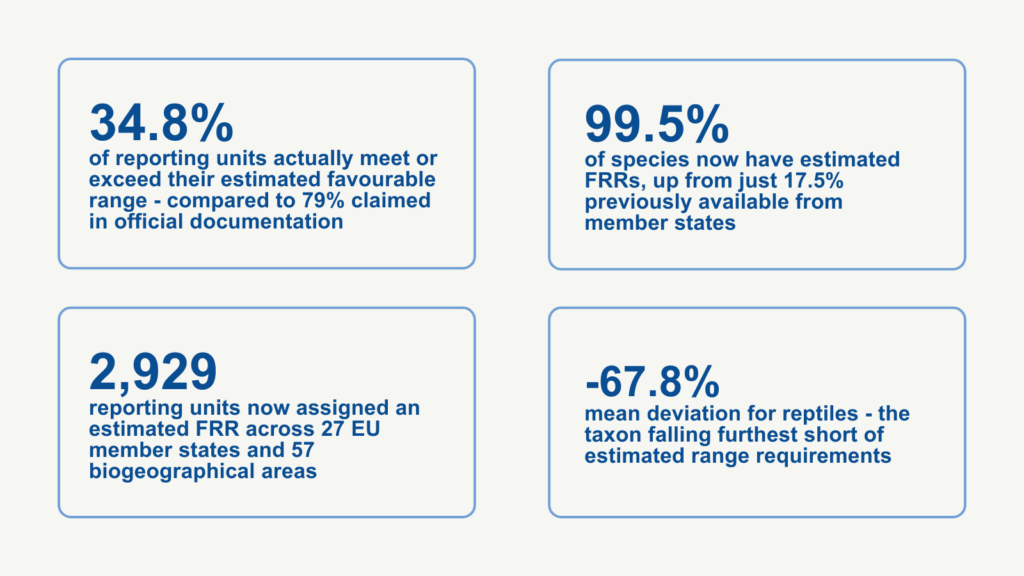
The discrepancy between official reports and the study’s estimates highlights the need for standardised recording and integration in conservation assessments. The research underscores the benefits of data-driven approaches, especially as the EU prepares for its fourth reporting cycle, which will phase out qualitative indicators.
The projected estimates show that geographically, France, Italy, and Romania have the highest number of reporting units falling below estimated FRR thresholds, reflecting long-standing habitat fragmentation in Southern and Central Europe. Taxonomically, reptiles, amphibians, and mammals all show substantial deficits towards their FRR, with many units exceeding a -75% deviation from their targets.
Practical Applications
The study emphasises that its framework is designed to complement, rather than replace, expert-led assessments. By incorporating quantified uncertainty, the model provides flexible, reproducible and transparent estimates to support reporting in conservation status as well as informing conservation prioritizations. As indicative spatial metrics FRRs could support member states in allocating resources for conservation more effectively.
Access to Research
The full paper, “Improving the Classification of Wildlife Conservation Status to Support Nature Protection in the European Union,” is available open access in Conservation Letters (2026). All data and R scripts are freely accessible on FigShare. We encourage researchers, policymakers, and conservation practitioners across the EU to engage with this work as part of the ongoing conversation around the fourth reporting cycle.
Research Team
Marco Davoli, Sapienza University of Rome | Martin Jung, IIASA | Piero Visconti, IIASA | Carlo Rondinini, Sapienza University of Rome | Alessandra D’Alessio, Sapienza University of Rome | Michela Pacifici, Sapienza University of Rome