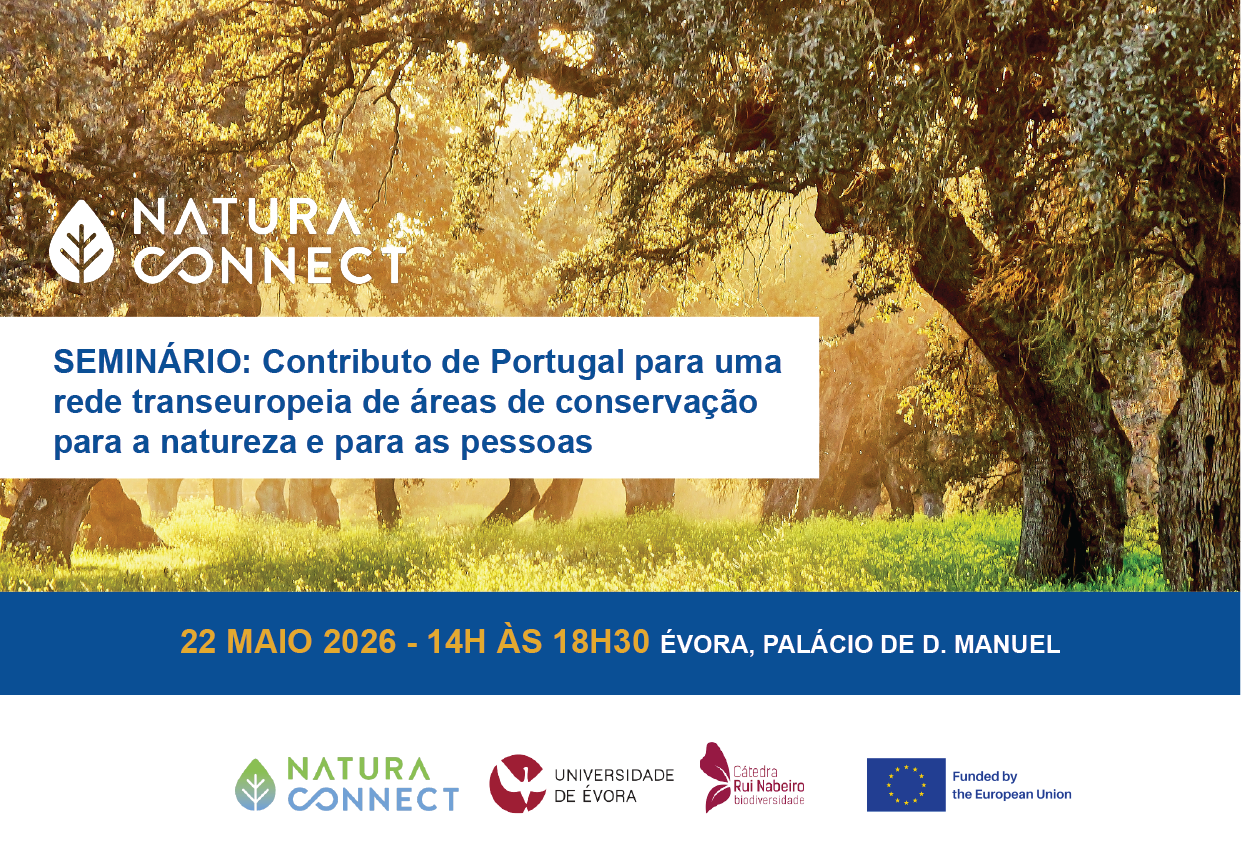
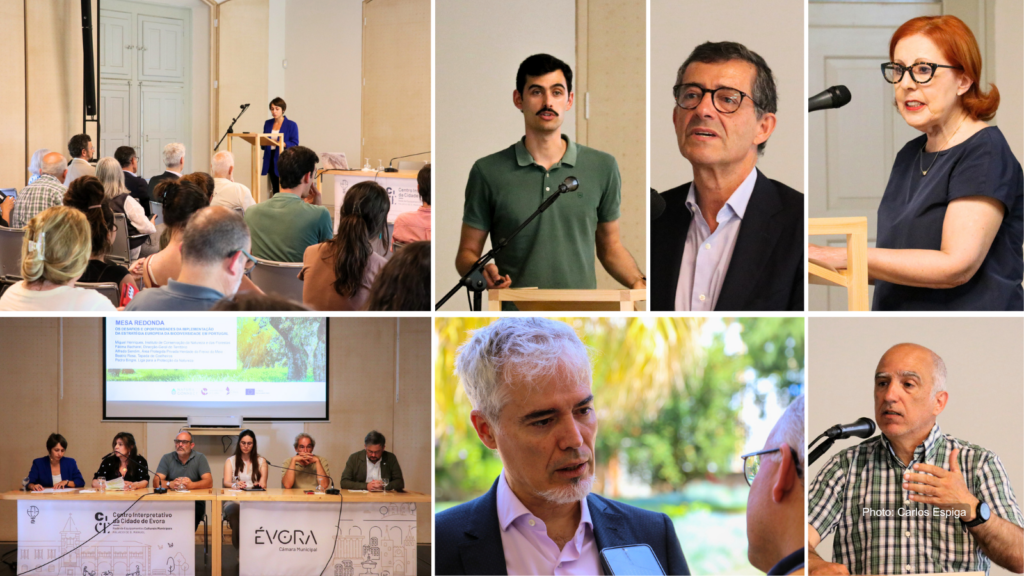
On International Biodiversity Day, 22 May, the NaturaConnect project hosted an event in Portugal to explore the challenges, opportunities and contributions to implementing a trans-European network for nature and people. The event provided an opportunity to share the project’s findings at both the European and national levels, and to discuss the challenges of implementing the European Biodiversity Strategy and the European Nature Restoration Regulation.
Closed by the Minister for the Environment and Energy, the event brought together more than 80 participants in Évora, predominantly representatives from central and regional public bodies, academia and non-governmental organisations.
Disseminating the Project results in Portugal
Henrique Pereira, from iDiv, opened the panel with a broad overview of the project, outlining its objectives, partners and the tools developed throughout its implementation. He presented in greater detail the key proposed solutions, including the identification of priority areas for the expansion of protected areas at European scale, the analysis of multiple land-use scenarios, and proposals for structural and functional connectivity towards a coherent trans-European network.
Bárbara Pais, from the University of Évora, reported on activities carried out in Portugal, focusing on multi-stakeholder engagement and capacity building for nature conservation and spatial planning professionals. She presented the findings of the Think Tank NaturaConnect.PT and the feedback received from participants across the various webinars and training sessions organised. She concluded her presentation by outlining the analytical methodology employed, which enabled the proposal of an optimised network of ecological corridors that is functional, persistent and ecologically robust, connecting protected areas and the Natura 2000 network across Portugal.
Daniel Veríssimo, from Rewilding Europe, focused his presentation on funding opportunities for biodiversity conservation. He outlined available public financing programmes and presented innovative solutions already being implemented across Europe, emphasising the need for Portugal to be “creative” in its pursuit of funding. He illustrated his points with European examples and referenced the documents produced in this context throughout the project, including this policy brief and the white paper issued by the NaturaConnect.PT Think Tank.
Closing the first panel, Miguel Bastos Araújo, from the University of Évora, reflected on the target of placing 10% of Portugal’s territory under strict protection, drawing on outcomes from the most recent NaturaConnect.PT Think Tank session. In a country where only around 3% of forested land is publicly owned, Miguel highlighted the need for the state to acquire land of high ecological value, identifying as priorities existing protected areas, zones already mapped as relevant for ecological connectivity or with strong restoration potential, and areas where private land has been abandoned, fragmented or is without effective management capacity.
What is lacking is scale, political mandate and strategic clarity.
He reinforced that strict conservation must be conceived as a network, rather than a collection of isolated islands, arguing further that “the 10% strict conservation target should be built, in significant part, from these windows of opportunity — where nature has already begun the work, and where the state can achieve a great deal with relatively little.”
Round Table: Challenges and opportunities for the implementation of the EU Biodiversity strategy – a multisectoral approach
The NaturaConnect project recognises that achieving the targets set out in the Biodiversity Strategy requires a collective effort involving both public and private actors. The round table reflected this vision, bringing together guests representing public bodies, private protected areas, the agricultural sector and non-governmental organisations.
Miguel Henriques, from ICNF (National Agency for Nature Conservation), highlighted the need to add criteria and verification methods to ensure that the areas proposed by Portugal in pursuit of the 30% protection target are genuinely aligned with conservation objectives. In 2023, Portugal announced the inclusion of Geoparks, Biosphere Reserves and Ramsar sites, a step that would bring 34.8% of the national territory under protection — though the scientific justification has yet to be formally presented to the European Union. He also noted the potential contribution that OECMs and privately protected areas could make towards these targets.
Alfredo Cunhal Sendim, from the private protected area (PPA) of Montado do Freixo do Meio, explained the motivation behind and the process of establishing the PPA. He described efforts to bring scientific knowledge to bear on the agricultural practices of the montado (Mediterranean agroecosystem) he manages, and stressed the need for greater awareness among producers to ensure that economic rationale incorporates, values and acknowledges the dependence of biodiverse and healthy ecosystems.
Beatriz Rosa, from Tapada de Coelheiros — an estate producing wine, nuts and sheep under organic certification — echoed this view. Drawing on the example of the estate, which began introducing biodiversity-promoting measures more than two decades ago, she argued that agricultural production must be aligned with ecological integrity. Both speakers, nonetheless, acknowledged that the market has yet to place an economic value on conscientious production, and that a great deal remains to be done before products with positive ecosystem impacts receive the recognition they deserve.
Pedro Bingre, representing LPN — an environmental NGO that owns 1,800 hectares in the country’s ecologically sensitive steppe zone — noted that “biodiversity production” lies at the heart of the organisation’s work. He also commented on the difficulties of effective forest management, particularly in central and northern Portugal, where private land is highly fragmented into smallholdings. It is estimated that the owners of roughly 60% of this territory are unknown, owing to undivided inheritances and the absence of an up-to-date land registry. He underlined the need for legal certainty and clear impetus from public bodies to identify and manage these neglected areas.
Finally, Fátima Bacharel, from the Directorate-General for the Territory (the national spatial planning agency), presented the land planning instruments, with particular focus on those that directly reinforce ecological connectivity. She reflected on the need to align and prioritise measures and actions to operationalise these instruments, which frequently overlap in planning terms yet have a limited footprint on the ground. She argued for a socio-ecological capillarity approach to harmonising the various instruments, pointing to existing examples of good practice in financial incentives that successfully combine productivity with conservation, and suggesting these could be replicated elsewhere in the country.
The session was closed by the Minister for the Environment and Energy, Maria da Graça Carvalho, who provided an update on the progress of the National Nature Restoration Plan and outlined the financing measures already made available for the recovery of marine, urban and freshwater ecosystems.
Download presentations:
- Barbara Pais: Resultados do projecto NaturaConnect em Portugal
- Daniel Verissimo: Opções de Financiamento – Portugal Áreas Protegidas e Corredores Ecológicos
- Henrique Pereira: Resultados do projecto NaturaConnect na Europa
Useful links:
- Register for our final event: https://naturaconnect.idiv.de/events/registration
- Learning Platform: https://www.europeannatureacademy.com/course/naturaconnect
- Portuguese Connectivity Analysis: Optimised corridors to connect Protected Areas and Natura2000 sites